BY PAULA CULBERTSON
Homelessness and housing insecurity take different forms in Southwest Virginia, where older adults face rising costs, deteriorating homes and a shortage of affordable places to live.
The older man who answered the door was wearing a heavy coat, a toboggan and boots.
Kayla Mullins, a care coordinator with Mountain Empire Older Citizens, thought he was preparing to leave. She offered to come back another time.
“No, I’m not going anywhere,” he told her. “Come in, but don’t mind the mess.”
Inside, Mullins found a house that was no longer safe to live in. Parts of the ceiling were collapsing. Insulation hung from openings overhead, and mold had developed where water had entered the house. The floors were deteriorating, and in places, daylight showed through the walls.
He ran the heat constantly, but the house stayed cold. His unpaid electric bill had accumulated to more than $2,000.
The man, a retired factory worker in his late 60s, had lost his wife three years earlier. As his health declined, he struggled to keep up with repairs to the aging house.
He had recently returned home after a nursing home stay following a fall that left him outside for five hours before someone found him. He had been referred to MEOC for home-delivered meals.
Mullins began arranging meal deliveries. The agency also provided $300 in assistance and helped secure additional support from other community resources to keep his electricity connected.
But the conditions Mullins encountered presented a problem that meals and emergency heating assistance could not address.
He had a house. What he didn’t have was a safe, warm place to live.
His circumstances illustrate a form of housing insecurity that often receives less attention than people sleeping outdoors or staying in emergency shelters. Across Southwest Virginia, some older adults remain in homes that have become unsafe or unaffordable because they have nowhere else to go.
The issue is particularly relevant in a region where nearly three in 10 residents are older adults. According to 2025 U.S. Census Bureau estimates, approximately 24,000 people age 60 or older live in Lee, Scott and Wise counties and the city of Norton.
Housing insecurity among older adults was the focus of an Oct. 7 screening of “No Place to Grow Old,” a documentary following three older adults experiencing homelessness in Portland, Oregon.
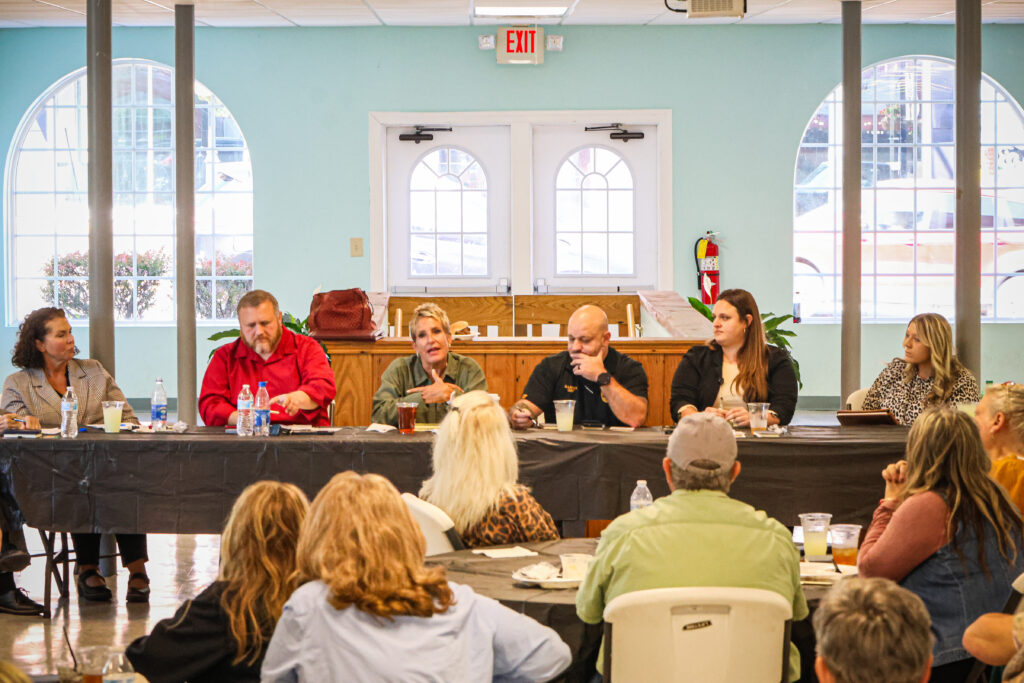
MEOC invited representatives from housing, homelessness services, health care, social services, law enforcement and aging services to the Lee Theatre in Pennington Gap for the screening and a panel discussion about the challenges facing older adults in Southwest Virginia.
The problems described by local service providers extend beyond the absence of a place to sleep. They include deteriorating homes, limited incomes, rising household expenses and a shortage of housing that older adults can afford and safely occupy.
A problem that isn’t always visible
The number of older adults experiencing homelessness in Southwest Virginia is difficult to determine.
Unlike the more visible forms of homelessness, housing instability in rural communities can be harder to recognize. Some older adults stay temporarily in motels, sleep on friends’ couches or move from one relative’s home to another.
Marybeth Matthews-Adkins, executive director of Family Crisis Support Services, said these less visible forms of homelessness make it difficult to capture the full extent of the problem.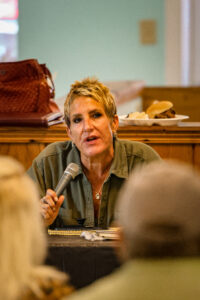
Her organization serves people experiencing homelessness and victims of domestic violence and sexual assault. Its services include emergency shelter, homelessness prevention, housing assistance and other support for individuals and families in crisis.
Matthews-Adkins described the limitations of point-in-time counts, which attempt to estimate homelessness on a single night. People staying temporarily with relatives or friends, for example, may not appear in those figures even though they lack stable housing.
For older adults, housing insecurity also includes circumstances that might not meet a formal definition of homelessness but still threaten their health and safety.
In an interview before the Oct. 7 event, Tiffany Jacobs, MEOC’s director of care coordination, described the housing problems agency care coordinators encounter while helping older adults remain in their homes.
Staff regularly encounter houses with leaking roofs, deteriorating floors, damaged foundations and other conditions that make daily life difficult or dangerous. Some homes lack reliable heat or other basic utilities.
Jacobs estimated that MEOC care coordinators encounter two or three homes each week with unsafe or unsanitary conditions requiring attention.
The problems can accumulate over years, particularly when homeowners have limited incomes and cannot afford repairs. A leaking roof may go unrepaired until water damages ceilings and floors. A deteriorating porch may eventually make it difficult for someone with limited mobility to enter or leave the house.
Accessibility presents another challenge. Even a home in relatively good condition can become difficult to navigate as an older adult’s mobility changes. Census survey data for 2019-2023 show that about one-third of older adults in MEOC’s service area have difficulty walking or climbing stairs. Yet modifications such as wheelchair ramps or accessible bathrooms may be beyond what someone on a limited income can afford.
For an older adult who has lived in the same home for decades, moving may be both financially and emotionally difficult.
And even when someone is willing to leave, finding another place to live presents its own challenges.
The cost of a place to live
For older adults with the lowest incomes, a modest apartment can consume most of a monthly check.
About 17% of older adults in Lee, Scott and Wise counties and the city of Norton live below the poverty line, roughly twice the statewide rate, according to Census survey data for 2019-2023.
For fiscal year 2027, the federal fair market rent for a one-bedroom unit in Wise County is $722 per month. Fair market rent is a benchmark used in federal housing programs and includes an allowance for tenant-paid utilities.
For someone living on Supplemental Security Income (SSI), for example, that amount could be difficult to afford. SSI provides monthly payments to older adults and people with qualifying disabilities who have very limited income and resources. The maximum federal payment for an individual in 2026 is $994 per month.
At that rent, housing costs would consume nearly 73% of the monthly payment, leaving approximately $272 for food, medications, transportation and other expenses.
That comparison illustrates the challenge of renting without housing assistance. People living in subsidized housing generally pay a portion of their adjusted income toward rent, but obtaining that assistance can involve long waits.
For homeowners, the financial pressures are different but can be just as severe.
An older adult may own a house outright yet struggle to pay property taxes, insurance, utilities and repairs. A home that is poorly insulated or structurally damaged can be especially expensive to heat.
Matthews-Adkins described the difficulty many households face as basic living expenses consume more of their incomes.
“People can’t make it,” she said.
MEOC care coordinators see the effects of those financial pressures regularly.
Jacobs said staff receive calls nearly every day from people seeking assistance with electricity, water or rent. Some older adults struggle to maintain basic utilities while also paying for food, medications and other necessities.
A medical emergency, the death of a spouse or another unexpected expense can make an already difficult financial situation unmanageable.
The challenge of finding affordable housing
Even when an older adult qualifies for housing assistance, finding an available apartment may take months.
“It’s not that there’s so much a lack of housing, it’s a lack of affordable housing that fits the budget of some of our elderly, some of our citizens that have very limited means of income,” said Zach Bowen, executive director of the Wise County Redevelopment and Housing Authority.
The authority operates public housing properties and administers the federal Housing Choice Voucher program, commonly called Section 8. Both programs help eligible households afford housing, but neither guarantees that an appropriate unit will be available when someone needs it.
 Bowen said waiting lists for some properties suited to older adults include 30 to 40 applicants, with relatively little turnover.
For voucher holders, finding a willing landlord is only part of the process. Properties also must meet program inspection requirements. When a unit fails inspection, necessary repairs can delay a move.
The shortage is particularly difficult for older adults who need accessible housing, cannot manage stairs or require a location near medical care and other services.
Other obstacles aren’t necessarily related to income.
Joie Cantrell, co-chair of Higher Ground Women’s Recovery Residence, which provides housing and support for women recovering from substance use disorders, described how a person’s history and circumstances can affect access to housing. She said criminal records, for example, can create additional barriers for people trying to establish stable living arrangements.
Some individuals also need support services in addition to an affordable place to live.
Frontier Health’s Permanent Supportive Housing program combines rental assistance with services for eligible individuals with serious mental illness.
Family Crisis Support Services also offers assistance intended to prevent homelessness and help people regain housing stability.
But the availability of individual programs does not eliminate the difficulty of navigating multiple needs at once.
A person facing eviction may need financial assistance, help locating another apartment and transportation to appointments. Someone leaving a hospital or nursing facility may need accessible housing and ongoing support. An older homeowner may need extensive repairs that exceed the resources available through local assistance programs.
Finding help often means coordinating several organizations, each with its own eligibility requirements, resources and limitations.
When repairs aren’t enough
For older adults living in deteriorating houses, repairing the existing home may seem like the most practical solution at first.
But some houses have sustained so much damage that repairs would cost more than the owner can afford, even with assistance.
Jacobs said MEOC works with organizations and volunteer groups that provide home repairs when resources are available. Those groups face limited funding, long waiting lists and requests that sometimes exceed what they can reasonably accomplish.
 In some cases, Jacobs said, relocating an older adult to affordable housing is more realistic than trying to make a badly damaged house safe.
That was the challenge facing Mullins and the man she had visited.
He initially wanted to remain in his house and hoped the problems could be repaired.
Mullins continued working with him, discussing his options and helping him understand the difficulties involved in making the house safe.
“He wanted to stay in his home, and I understood that. But I was concerned about his safety. I wanted him to know he had options and that I would help him through the process,” Mullins said.
Eventually, he agreed to look for another place to live.
Mullins helped him apply for housing assistance. Although he was approved, that did not mean an apartment was immediately available.
They waited for an opening.
Then freezing temperatures caused pipes in his house to burst, making his situation even more urgent.
The local Department of Social Services helped arrange a temporary motel stay while Mullins continued searching for permanent housing.
But the motel assistance was nearing its end, and an apartment still had not become available.
Finally, an opening
After weeks of searching and waiting, Mullins received a call from an apartment complex.
A unit would be available in about a month. It was welcome news, but the man needed somewhere to live sooner.
About five minutes later, another apartment complex called. This one had an apartment available immediately.
“We had waited so long for something to open up, and then we got two calls within minutes of each other. I was just relieved that he finally had somewhere safe to go,” Mullins said.
The man chose the apartment that was ready, a unit in public housing.
The Department of Social Services helped cover his motel stay and apartment deposit.
With no one else available to help him move, Mullins and her husband stepped in on their own time to help him get settled.
After months of uncertainty, he had a safe place to live.
Mullins said he has since become more socially active, a change from the isolation and difficult conditions he experienced in his former home.
In a 2025 MEOC interview shortly after he moved in, the man reflected on living in the cold.
“Being cold and being hungry will make you think — and appreciate life,” he said.
A problem larger than one agency
The challenges facing older adults without safe, affordable housing brought together organizations whose work does not always overlap.
During the Oct. 7 panel discussion, moderator Judy Willis, a retired MEOC care coordination director, urged participants to build on the discussion and work together toward solutions.
“We need a coalition to address it, not just talk about it,” she said.
Bowen also emphasized the need for a regional approach.
“It’s no longer just a village,” he said. “It takes a region now.”
MEOC Executive Director Michael K. Wampler said the agency would follow up with participants about possible next steps. As of mid-October, no formal coalition had been established.
For Mullins’ client, cooperation among agencies helped turn a long and uncertain search into a successful move. MEOC provided care coordination, the Department of Social Services helped with temporary lodging and his apartment deposit, and a unit in public housing became available.
His circumstances are not the only ones MEOC care coordinators encounter, and not every housing search ends with an available apartment.
But his experience shows what can happen when the right resources come together at the right time.
The house he left behind was falling apart. His new apartment is safe and warm.